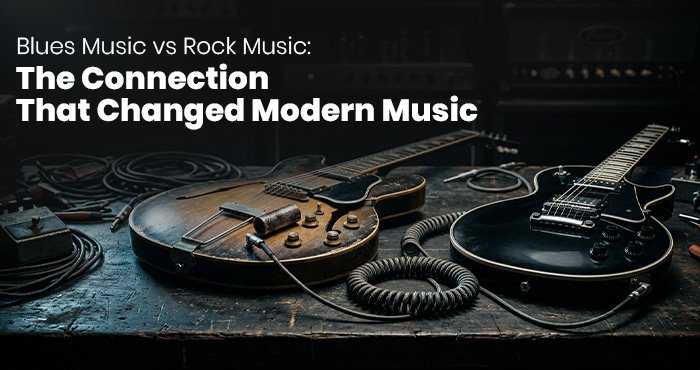
Ask most people what the origin of rock music is, and they’ll tell you it was Elvis Presley or perhaps Chuck Berry. Talk to a musicologist about it, and he or she will take you even farther back into time, right back to the Mississippi Delta, to the wooden porch of some humble home, where men and women were singing about their hardships with little more than an acoustic guitar and raw passion. The real deal behind blues music vs rock music isn’t really a battle between two distinct musical forms of expression. Rather, it’s the story of how one gave birth to the other.
Where It All Began: Blues Music and Its Raw Roots
The blues was first heard in the southern United States at the end of the 19th century. The African-American musicians in the Mississippi Delta area used African beats, work songs, and gospel music to create their own unique music. This was not composed music, nor was it performed by skilled musicians. It came directly from the musicians’ experience and the honest expression of their feelings.
By the early 1900s, blues music influence had already begun spreading beyond the South. These cities became home to the music. The guitar was plugged into an amplifier. It got louder and louder. It became palpable to people who felt it in the flesh. Everything else that developed in American popular music is somehow linked to that original flame of the blues.
The 12-Bar Blues: A Blueprint That Never Stopped Being Used
Another element of blues music that was bequeathed to subsequent music genres is the 12-bar blues form. This is essentially a chord progression that takes the shape of twelve bars. What is notable about this chord progression is that it provides a natural rhythm of tension and resolution. Simple though it may sound, there is much musical space for innovation and improvisation here.
The 12-bar blues form was adopted by rock and roll almost instantly. Early rock music pieces used it as is, and even though the genre progressed and developed new forms of songwriting, it did not give up on the 12-bar blues form. It continues to use it today, sometimes adorned by distorted guitars and heavy beats, but the backbone of rock music was provided by blues.
How Blues Created Rock Music Step by Step
The blues rock history timeline moves fast once you know what to look for. Muddy Waters, Howlin’ Wolf, and other musicians of that time period were playing a type of electric blues that was extremely powerful. It was loud, raw, energetic music. And when the younger generation of musicians listened to that music, some connection was made between them and what the future held for them.
How blues created rock music becomes clearest when you look at the early rock and roll pioneers. Chuck Berry used blues guitar licks and combined them with a powerful rhythmic beat. Little Richard provided energy and stage presence. Elvis Presley used blues form and phrase and presented it to a new white audience that had never seen anything like that before. All of these were direct appropriations from the blues style. Rock music was not created out of thin air; it was reinvented from something else that was already in existence and was powerful in its own right.
The British Invasion and the Blues Connection
Here is something fascinating about blues influence on rock music that often gets overlooked. British bands were captivated by American blues in the early 1960s. This list included The Rolling Stones, Led Zeppelin, Eric Clapton, and The Animals, among others. These musicians immersed themselves in studying old blues records as a true student would with a textbook.
They then presented what they had learned to Americans in the form of rock music, allowing Americans to recognize their blues traditions through British rock music. The evolution of rock guitar proceeded at an enormous pace during this time period. Blues musicians had practiced such techniques as string bending, vibrato, and call and response for many years, and now these techniques have become integral to rock guitar music. Guitar solos became the main characteristic of rock music due to its influence from blues.
Difference Between Blues and Rock: What Actually Separates Them
Despite all their similarities, however, blues and rock do have certain distinctive qualities that should be mentioned separately. The understanding of the difference between blues and rock allows you to better see what is unique about them individually.
Below is a list of some of those distinctions:
- Tempo and rhythm – blues usually sound slow and methodical. Rock goes for something stronger, louder, and faster.
- Emotion – blues is based on sorrow, nostalgia, and life difficulties. Rock expresses rebellion, enthusiasm, and liberation.
- Structure of song – blues uses the 12-bar format quite frequently. Rock has more varied song structures.
- Tone of guitar – blues guitar sound is typically soft and clean. Rock guitar sound often features distortion and power chords.
- Lyrics – the lyrics in blues songs are mostly autobiographical. Rock lyrics explore much wider themes.
These characteristics do not mean that one music genre is superior to another. They simply point out how rock created its new form out of the basic components offered by blues.
Famous Blues Rock Artists Who Lived in Both Worlds
A few others declined to make a choice between blues and rock. Instead, they put one foot into each genre and came up with something that had elements of both genres. The famous blues rock artists were the most revered musicians in the history of music because they knew where the two genres intersected.
One of the most obvious examples would be Stevie Ray Vaughan. He was a musician who blended the emotional qualities of a blues artist with the rock energy of an artist. The sound of his guitar playing, his phrases, and his stage personality perfectly illustrated what such a fusion of these two musical directions sounds like. Jimi Hendrix revolutionized the sound of rock music by introducing blues emotions with experiments with sounds in a manner no one had ever tried before. And in more recent times, there are still musicians who follow the same tradition.
Michigan Mick Music and the Living Blues Rock Tradition
This relationship is not only part of history; it is something that is relevant today as well, in musicians who play the two genres with sincerity. Michigan Mick Music is a perfect example of such a living tradition; it is a product of Detroit Blues, and it was developed based on the same authenticity that characterized the genre in the beginning.
Blues music played by Michigan Mick Music is not a thing of the past; on the contrary, it is something that is relevant even today in terms of content and meaning. Discovering such music will provide you with an opportunity to find out everything you have read here before in this blog. Go to michiganmick.com.
Conclusion
The story of blues music vs rock music is really the story of where modern music came from. The seed was blues, and rock was what came from it upon planting in the new soil. The blues inspired rock bands that have changed the course of history have not left blues behind but taken it into the future and new times.
The guitar solos that you have listened to, the chord sequences that gave you goose bumps and emotions, the songs that were rooted in the reality of the moment, all of them can trace their roots back to the blues. Listen to Michigan Mick Music and see what it means when an artist knows how to draw on that connection each time he plays.